The Way to Here
I felt immortal well into my forties. Long past the age when a man should know better.
My daughter was born when I was 43. In the NICU, looking into her deep purple eyes, I saw myself. Something moved in the chain. One life passing its weight to the next. The veil of immortality began to thin. I knew, without knowing how, that my time was no longer entirely my own. I had two things left to do: keep her safe and teach her to make good decisions.
Fifteen years later, my daughter and I woke high on Mount Rainier.
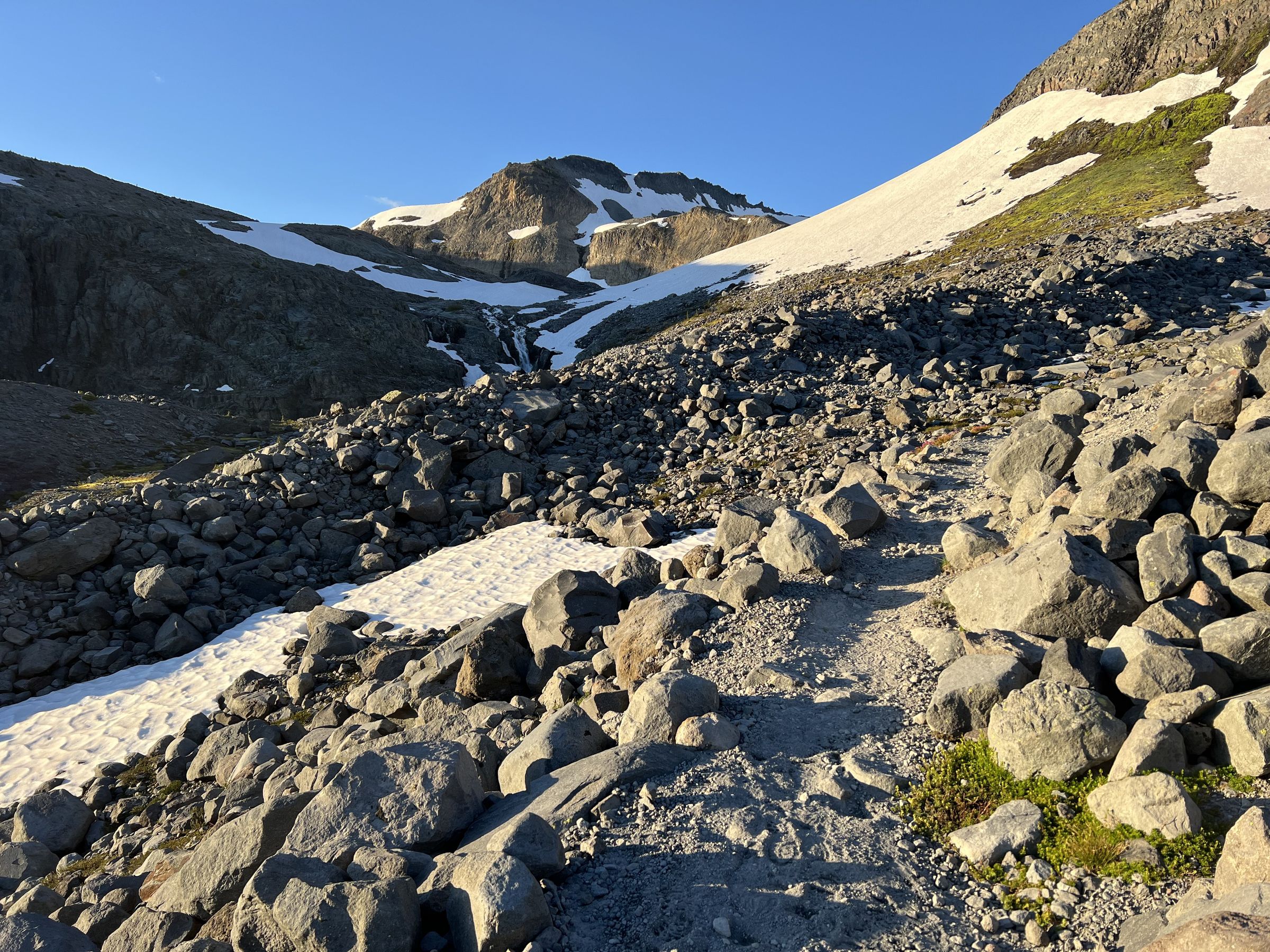
Morning came hard and blue off the glaciers. Talus and meadow fell away beneath us. The mountain's shadow still held our camp in the cold. Somewhere below, the volcano breathed. Ancient, patient. Waiting. Asking.
The girl with the purple eyes was a young woman now. Stronger than I had ever been, making her way through the world with less help from me than I knew how to give. I left her in the tent. There was no one else on that side of the mountain.
I kept climbing.
I watched the route ahead, looking around each turn, each rise, for what might be waiting for her. I had done the same thing for fifteen years. Looking ahead. Trying to see trouble before it found her.
Then I stopped.
I looked down at our camp. Then up the mountain.
The sunlight worked its way down the slope, taking back the darkness. Eventually it reached my face. Warm. Bright. I stood there and let it.
All those years of looking ahead. Standing there, for the first time, I looked back. Not at my life. At everything before it. The long run of accidents and escapes that ended with me on this slope, still breathing, still able, with her asleep below. How had any of it held?
To understand how I got there, I had to go back a long way.
The Big Bang
13.8 billion years ago
The first gamble was the rules themselves. In its first moments the universe had to come out right on several counts at once, or it would have stayed a thin, dark gas forever, with nobody around to notice.
Start with the leftovers. Matter and antimatter destroy each other on contact, and the early universe made them in almost equal amounts. Almost. For roughly every billion pairs, one extra particle of matter was left over when the rest had cancelled out. Everything that exists came out of that remainder: the mountain, the glacier, the tent, the girl asleep inside it, me. One particle in roughly a billion survived the cancelling, and we are made of it.
The expansion ran at the right speed. A little faster and matter would have thinned out too far to ever gather into stars. A little slower and the whole thing would have fallen back in on itself before it got started.
The ripples were the right size. The young universe was smooth to about one part in 100,000. Any smoother and gravity would have had nothing to grab, and no galaxies would have formed. Any lumpier and most of it would have collapsed into black holes.
The forces came out balanced. Gravity, electromagnetism and the force that binds the heart of an atom landed in a narrow range that lets atoms hold together. Without stable atoms there is no chemistry, and without chemistry there are no bodies to stand on mountains.
And empty space carried almost no energy. The energy of the vacuum turns out to be tiny compared with what our best theories say it should be. If it had been much larger, the universe would have flown apart before a single star could light.
The first stars
About 13.6 billion years ago
Good rules weren't enough. Something had to forge the heavier stuff I'm made of, and the window for it was narrow.
First, gravity beat heat. Clouds of hydrogen cooled enough to collapse in on themselves and ignite. No stars, no carbon, no oxygen, no iron, and nothing to build a man from.
Then there's the carbon trick. Carbon forms inside stars only because three helium nuclei can fuse by way of one finely placed energy level, a door left open at exactly the right height. By one 2013 calculation, change the mass of the lightest quarks, the particles inside every proton and neutron, by more than two or three percent and the universe runs short of carbon or of oxygen. Every living thing is built on carbon. The margin for error was that thin.
Oxygen survived the same furnace. Stars made it without burning all their carbon into it, so the universe ended up with plenty of both: the raw material for water, and for breath.
Then the stars had to die, and die violently. The big ones blew apart and flung carbon, oxygen, calcium and iron across space. That debris drifted, gathered, and eventually became the Earth and everything on it. The calcium in my bones and the iron in my blood were once inside a star that exploded before the Sun existed.
Some of the gold and iodine on Earth, perhaps a good share of it, was forged later still, when dead stars smashed into one another. My thyroid runs on that iodine. I carry the wreckage of collisions older than the planet.
The Sun and Earth
4.6 billion years ago
Star dust collapsed into the Sun and its planets. Almost everything about the place I was born could have gone another way.
Something set off the collapse. A cloud of gas fell in on itself to form the Sun, and science is still debating what pushed it. One leading idea is the shockwave from a nearby exploding star. Even our beginning may have started with someone else's ending.
It was the right kind of star. The Sun is steady and long-lived, and life took nearly four billion years to get from the first cell to me. A big star would have burned out in a few million years. A small one flares violently enough to scour a planet bare.
Earth landed at the right distance, in the narrow band where water stays liquid. A little closer and it goes the way of Venus. A little farther out and it freezes like Mars.
Then something the size of Mars slammed into the young Earth. It should have been the end. Instead the debris became the Moon, and the Moon steadies Earth's tilt, which keeps the climate stable enough for life to settle in for the long haul.
And Earth needed a shield and a bodyguard. Its molten iron core generates a magnetic field that helps turn aside the solar wind. The field isn't the whole reason we kept our air and water; gravity, chemistry and our distance from the Sun all play a part, and Venus has almost no magnetic field and a crushing atmosphere. But it's one more thing that came out in our favour. Jupiter's gravity throws some incoming comets and asteroids off course, though astronomers point out that it flings some our way as well. I've never once thanked either of them.
Life begins
About 4 billion years ago
Chemistry crossed into biology, and nobody knows how likely that was. Then life had to survive itself.
The water stayed. Earth kept its oceans through billions of years of bombardment and a young Sun that blew much of the early atmosphere into space. Every cell runs on liquid water. Without the oceans, nothing starts.
Somewhere, molecules began making copies of themselves. Nobody knows how. As far as we can tell it happened only once, because every living thing shares a single genetic code. The bacteria in the soil, the firs on the moraine, my daughter and I all read from the same book.
Then one cell swallowed another and, against every usual outcome, didn't digest it. The two learned to live as one, and that partnership became the complex cell behind every plant, animal and fungus on Earth. As far as we know, it happened only once. Science is still working out exactly when, but life had been nothing but single cells for an enormously long time before it did. Every complex thing that has ever lived descends from that single act of restraint.
Then life survived its own pollution. Microbes filled the air with oxygen, which was poison to most life at the time. The survivors learned to breathe it, and the poison became the fuel that powers animals like us.
And the planet thawed. Earth froze nearly pole to pole at least twice. Volcanoes slowly pumped out enough carbon dioxide to melt it, or life would have stayed locked under the ice.
After the sun reached me, I filled our water bottles from the meltwater. You could see where it came from, pouring out from under the glacier and running across the moraine. I drank it, then dipped my hands and face in it, then put my whole head under. It was so cold it took my breath away.
I don't know that I've ever felt anything purer. I could taste the earth in it. I could taste iron. I could almost taste the beginning of the universe.
Surviving the extinctions
252 and 66 million years ago
Life came close to being erased more than once. My ancestors slipped through every time.
The worst was the Great Dying, 252 million years ago. Massive volcanic eruptions in Siberia heated the planet and stripped the oxygen from the oceans. More than 95 percent of marine species vanished, and about 70 percent of species on land. My ancestors lived on land, and they were among the few that made it.
It wasn't the only one. Besides the Great Dying and the asteroid, three other mass extinctions each wiped out most of the species alive at the time. My line had to come through all five. One break, anywhere, and there is no me.
Sixty-six million years ago, a rock about ten kilometres wide struck what is now Mexico. Science is still debating the details, but some researchers argue that if it had arrived a little earlier or later and landed in deep ocean, it would have done far less damage, and the dinosaurs might still rule. Of the species that had come through everything before it, roughly three in four were gone.
Our mammal ancestors survived by being small, buried and not fussy. They were shrew-sized, they hid underground, and they ate almost anything. The big animals starved. The small ones waited it out.
When the dust settled, the dinosaurs' exit had opened the door. Mammals spread into the empty country and grew larger. That opening led, eventually, to primates, and then to us.
Humans emerge
900,000 to 300,000 years ago
The closest calls for our own kind came before our species even existed.
As Africa's forests thinned into grassland, our ancestors came down from the trees and began walking upright. That freed their hands for tools, and tools meant more food and a better chance against whatever was hunting them.
They learned to control fire, and to cook. Cooked food gives up far more energy than raw, and that extra fuel helped power a growing brain.
Then came the near miss. One genetic study, published in 2023, suggests that around 900,000 years ago the effective population size of our ancestors fell to roughly 1,280 individuals, and that the bottleneck lasted more than 100,000 years. That doesn't mean there were exactly 1,280 people alive. It means the breeding population was extraordinarily small. Science is still debating it, and some researchers think the crash was regional rather than global. But if it's right, a single drought or a single disease could have ended the human story before it began.
Ice ages swung the climate between extremes. About 74,000 years ago a supervolcano erupted at Toba, in Sumatra. Science is still debating how hard it hit our ancestors, but they had to get through it.
Then small groups walked out of Africa into Asia and Europe, where they met other kinds of humans, the Neanderthals among them. Every one of those other kinds died out. Ours is the only one left.
The unbroken chain
Every generation since
Every person who came before me ran the same gauntlet and got through it. Not one of them failed.
For most of human history about half of all children died before they grew up. Every one of my ancestors was in the half that lived. Give each of them a coin-flip chance of reaching adulthood, run it across roughly ten thousand generations, and the chance of an unbroken line of survivors comes out at one in ten to the power of 3,010. That's an illustrative model, not a measured probability for my own family; real lives don't run on coin tosses. But it gives the shape of the thing.
Childbirth killed huge numbers of mothers and babies. Every mother in my line came through it, and so did every child of hers who led to me.
Plague, smallpox, cholera, measles and countless nameless fevers swept through villages and cities. The Black Death alone killed roughly a third of Europe. My ancestors escaped or recovered, every time.
Wars, raids, crop failures and hard winters ended countless family lines. Mine wasn't one of them. They weren't trying to get me here. They were trying to get through the winter, feed their children, and see another spring.
And each of them, against all that, had to find someone at the right time and have a child who lived to do the same. Thousands of generations in a row, without a single break. That's the chain I felt move in the NICU. It had held for longer than I can imagine, and it had come down to her.
Up on the route, something in me, call it instinct, said I'd been away from her long enough. There were still dangers on that mountain. I turned around and went back to camp.
She was already up, sitting on a log wrapped in her sleeping bag. Waiting for me, or just thinking. I wondered which. I knew that look; I've worn it most of my life.
After good morning, it was the first thing I said to her: "You already look deep in thought."
She wanted to know where I'd gone. I told her, and said I was sorry if she'd worried. She's capable of taking care of herself, for the most part. I came back anyway.
One sperm, one egg
The moment I began
Then came the narrowest gate of all.
My parents had to be fertile at the same time in their lives. Fertility comes and goes with age and health, and their windows had to overlap.
They met. Out of billions of people, they crossed paths, and a missed bus or a different job could have kept them apart for good.
My mother was born with one to two million eggs, and only about four hundred were ever released. A different month means a different egg, and a different child.
On the night I was conceived, about a hundred million sperm set out, each carrying a different mix of my father. A few dozen reached the egg. One got in. A different night means a different winner, and a brother or sister standing on that mountain instead of me. Multiply one sperm in a hundred million by one egg in four hundred and you get about one in forty billion. That isn't a true probability for my birth. It's typical counts multiplied together, and it leaves out the odds of my parents meeting at all. But it shows how narrow the gate was.
And the pregnancy held. A good share of conceptions never reach birth. Mine made it through nine months.
Fifty-eight years
Birth to that morning
Being born was the start. Then came the living of it: infancy, childhood illness, reckless years and the long middle of a life, and still being able to stand on the side of a volcano at dawn with my daughter asleep below.
The first year alone was a hazard. When I was born, about two in every hundred American babies died before their first birthday. I wasn't one of them.
The diseases missed me. I was born a few years after the measles vaccine arrived. Before it, measles put about 48,000 Americans in hospital every year and killed four or five hundred. Every vaccine I was given closed a door that had stood open for every generation before mine.
Then there were the accidents. I survived a completely reckless childhood.
The ocean came closest. I was exhausted, out of breath. I couldn't save myself, and I was convinced no one else was coming. So I said it: I'm done. Here I am. Take me.
It didn't.
There were countless others, some I remember and plenty I never noticed. Accidents kill more young Americans than anything else. More than once, I should have been one of them.
Then came the decades when the body starts collecting its debts. Heart disease, cancer and the rest of what starts taking people in their forties and fifties have left me alone, so far. About one in seven American boys born around the time I was won't make it to fifty-eight.
And I'm still able. Not just alive, but strong enough to climb, with eyes to see the mountain and a daughter to share it with. Being here is one thing. Being able to take it in is another.
None of that was luck I earned. Neither was the rest.
I was born far from the fighting. My country was at war in Vietnam the year I arrived, but the war was half a world away. A boy born that year in Vietnam grew up inside it, and some of those boys died in it. Children born in Afghanistan have known decades of conflict. Nobody chose my country for me.
I wasn't born poor. Around the time I came into the world, a large share of humanity lived in extreme poverty. Being born into middle-class America put me on the right side of that line before I'd done a single thing.
I had the means to get there: a car, a job, money for gas and a campsite. Plenty of healthy fifty-eight-year-olds will never have the means to stand on that mountain.
I had time that belonged to me. Free time is rare in the human story. Most people who have ever lived spent nearly every waking hour working just to eat.
I had people who raised me, who fed me and kept me safe and taught me. Plenty of children survive without that. And I learned to read, which most people who have ever lived never did.
Then there's the part that took me longest to see. My daughter made the whole journey too. Every stop. The leftover matter, the dead stars, the thawed planet, the extinctions, the twelve hundred and eighty, the unbroken chain, one sperm and one egg, and fifteen years of her own. Two impossible roads, meeting on one mountain morning.
Every round, no retries
Any one of these, on its own, might not seem so unlikely. Some were near certainties. Some we can't even put a number on.
That isn't the point. The point is that every one of them had to go right, in order, with no second tries. Lose a single round anywhere in 13.8 billion years and the game is over; there's nobody left to try again.
Win a coin toss once and it's nothing. Win it ten thousand times in a row and people would call it impossible. That's what it took to get me to that slope. It's what it took to get anyone anywhere.
How great minds have wrestled with it
What are we supposed to make of all this?
I'm not the first to stand somewhere and ask why. For more than two thousand years, people far wiser than me have wrestled with the same question, and they've split into roughly five camps.
The first says it's chance, so don't be afraid. Epicurus, and the Roman poet Lucretius after him, said everything is atoms colliding in a void, with no plan and no designer. Their point wasn't bleak. If you're a happy collision, there's no angry god to fear and nothing to dread after death. The right response is simply to enjoy being here.
"Death is nothing to us: for that which is dissolved is without sensation; and that which lacks sensation is nothing to us." (Epicurus, Principal Doctrines II; trans. Cyril Bailey)
The second says it's too ordered to be chance. Cicero, whom I've long admired, stages exactly this debate in On the Nature of the Gods. His Stoic speaker Balbus asks whether letters of the alphabet thrown on the ground at random would ever spell out a great epic poem, and if not, why anyone would expect atoms to fall into a world.
"...if a countless number of copies of the one-and-twenty letters of the alphabet, made of gold or what you will, were thrown together into some receptacle and then shaken out on the ground, it would be possible that they should produce the Annals of Ennius, all ready for the reader. I doubt whether chance could possibly succeed in producing even a single verse!" (Cicero, On the Nature of the Gods II.93, voiced by Balbus; trans. H. Rackham)
Then Cicero does something rare. He gives the sceptic Cotta a full and fair rebuttal. He shows both sides, lets the reader weigh them, and only at the very end offers his own leaning, gently.
"Here the conversation ended, and we parted, Velleius thinking Cotta's discourse to be the truer, while I felt that that of Balbus approximated more nearly to a semblance of the truth." (Cicero, closing On the Nature of the Gods III.95; trans. H. Rackham)
The third says it doesn't matter which, so live well. Marcus Aurelius keeps returning to the same fork, "either providence or atoms," and arrives at the same answer either way: do your duty, be grateful, act well today. Seneca says much the same about the time we're given.
"Do not act as if thou wert going to live ten thousand years." (Marcus Aurelius, Meditations IV.17; trans. George Long)
"It is not that we have a short time to live, but that we waste a lot of it." (Seneca, On the Shortness of Life; trans. C. D. N. Costa)
The fourth says it's a rare chance, so don't waste it. Buddhism offers the image of a blind turtle that surfaces once every hundred years in a vast ocean where a single wooden yoke floats. The chance of the turtle's head passing through the yoke, the Buddha says, is better than the chance of being born human. It's the feeling of one sperm and one egg, set down 2,500 years ago and used as a reason to live with purpose.
In the Chiggala Sutta, the Buddha asks whether such a turtle would ever put its neck through the yoke, and says that would happen sooner than a being, once lost, would regain the human state.
And then the modern voices. Leibniz asked why there is something rather than nothing at all. Carl Sagan saw us as the universe looking back at itself. Richard Dawkins turned the odds into gratitude. And Douglas Adams, with a grin, gave the sceptic's warning: of course the world fits us; we grew to fit it.
"We are going to die, and that makes us the lucky ones. Most people are never going to die because they are never going to be born." (Richard Dawkins, Unweaving the Rainbow)
"We are a way for the cosmos to know itself." (Carl Sagan, Cosmos, episode 1)
In The Salmon of Doubt, Adams imagines a puddle waking up one morning and deciding that the hole it sits in fits it so neatly that it must have been made to have it in it.
Same road, everyone
Here's what I keep coming back to. Every person alive made the same journey I did. The same matter left over from the Big Bang, the same exploded stars, the same narrow escapes from extinction, the same long line of survivors. Nobody arrived by a shortcut.
We spend a great deal of time dividing ourselves into tribes, nations and opposing camps. But trace the family tree far enough back and the distinctions begin to disappear. Go back far enough and everyone alive today descends from the same set of ancestors, even though we didn't all inherit DNA from every one of them. My ancestors are also the ancestors of the stranger I disagree with most. We are equal in the one thing none of us earned: being here at all.
Where we differ is what we're handed on arrival. Warren Buffett calls it the ovarian lottery: the place, the family and the era you're born into shape a life enormously, and nobody chooses them. The road behind us is the same. The starting line ahead is not. Both are worth remembering.
The sceptic's corner
The strongest case against reading all this as a miracle deserves a fair hearing. Cicero would expect nothing less.
Someone always wins. Every lottery has a winner, and the winner always feels chosen. Any person born was going to face odds just as long as mine.
Then there's survivorship bias. We only ever see the line that made it. The countless lines that ended left nobody behind to marvel at their bad luck.
And there's the puddle. As Douglas Adams put it, a puddle thinks its hole was made to fit it, when really the water took the shape of the hole. Maybe life fits the universe because life grew to fit it.
A sceptic can accept every fact in this essay and still call it chance. That's fair. But notice what doesn't change. The facts are the same either way, and I'm still here. Whether you call it luck or a miracle, the question of what to do with it is the same.
The fact that someone was bound to win doesn't make winning meaningless. It just means the winner shouldn't confuse survival with superiority.
From knowing to gratitude
Gratitude begins with understanding what there is to be grateful for. Now I know some of it: a universe that balanced, stars that died to make me, a planet that held on to its water, ancestors who made it through every winter, and one sperm, one egg, one night.
I don't think that gratitude needs to be pointed anywhere in particular. I bring my own beliefs to it; you can bring yours, or none. What matters is the noticing: this morning, this breath, the person beside you, who came down the same road.
I choose to treat what I've been given as a gift. That doesn't mean everything is fair, or that everyone gets the same one. But when you're handed a gift, you open it. You don't lament it, compare it with someone else's, or throw it away unopened.
I'm here. That's where everything else begins.
Still
Here's the part that's easy to miss. I've written about all of this as if it were history, something that happened back then. It isn't finished.
The atoms balanced at the Big Bang are holding together in my hands right now. The iron from a dead star is moving through my blood. I tasted it that morning, in water that came off a glacier. The chain that never broke isn't behind me. I'm the living end of it, and it's still holding, breath by breath.
As a boy, in the ocean, I said it: Here I am. Take me.
On the mountain I didn't say anything. I stood in the sun a while, then went back down, and there she was on the log, wrapped in her sleeping bag, deep in thought. Fifteen years old. Every stop behind her too, and all of her road still ahead.
Here I am. With her.
Notes and sources
Dates are approximate. Where science is still debating a point, the essay says so. Figures marked as illustrations are models, not measured probabilities.
- The Big Bang: The matter-antimatter asymmetry problem, CERN.
- The first stars: Foundations of carbon-based life leave little room for error, ScienceDaily, reporting Epelbaum et al., 2013.
- Surviving the extinctions: Permian extinction, Encyclopaedia Britannica; Mass extinctions, Our World in Data.
- Humans emerge: Human ancestors nearly went extinct 900,000 years ago, Scientific American.
- The unbroken chain: Child mortality in the past, Our World in Data, drawing on Volk and Atkinson, 2013.
- One sperm, one egg: Human fertilization: from gametes to a zygote, University of Minnesota; Human eggs: 9 fascinating facts, CBS News.
- Fifty-eight years: Cohort life table, males born 1970, Social Security Administration; US infant mortality rate, FRED; History of measles, CDC.
Quotations. Cicero, On the Nature of the Gods II.93 and III.95, trans. H. Rackham, Loeb Classical Library, 1933 (Book II, Book III). Epicurus, Principal Doctrines II, trans. Cyril Bailey (translations compared). Marcus Aurelius, Meditations IV.17, trans. George Long (text). Seneca, On the Shortness of Life, trans. C. D. N. Costa, Penguin Great Ideas, 2005. Richard Dawkins, Unweaving the Rainbow, 1998, opening lines. Carl Sagan, Cosmos: A Personal Voyage, episode 1, 1980 (transcript). The Buddha's turtle and Douglas Adams's puddle are paraphrased in the text, not quoted.