
Designing Edible Landscapes: The Overlooked Fruit Trees of the Maritime Northwest
A field guide to reliable fruit trees beyond the usual apples and plums
When designing edible landscapes in the maritime Northwest, the first constraint is climate.
Many fruit trees will grow here. Far fewer will produce consistently.
Our region combines cool summers, long wet springs, and persistent fungal pressure. Trees that thrive in warmer parts of the country often fail here for predictable reasons. Some never accumulate enough heat to ripen fruit. Others bloom during the rainy weeks of spring and lose their crop before it sets.
Over time, while working on landscapes across maritime climates like Seattle, Vancouver BC, and the San Juan Islands, I began keeping a working list of fruit trees that reliably produce in these conditions.
I love the projects where nothing’s off the table. Those are the most interesting ones, because they allow me to use species most people don’t realize can grow here, or to place them where the landscape naturally supports fruiting.
But just as often, good design requires restraint.
In the maritime Northwest, many trees will grow beautifully but never produce a dependable crop. A landscape can accommodate those trees when their role is structural, ornamental, or ecological. But when the goal is food, reliability matters.
This guide focuses on fruit trees that consistently produce in maritime Northwest conditions.
None are included simply because they survive.
Each appears here because it reliably fruits in our climate with ordinary care.
What follows is a working field guide to those trees. Each entry covers the practical questions growers and designers face: pollination, time to fruit, disease pressure, and the characteristics that make the tree useful in edible landscapes.
These aren’t experimental plantings. They’re fruit trees that work.
We’ll start with one that proves the point early in the season: the peach.
The Pendragon Design Guide: Reliable Edible Trees for the MNW
Before getting into the list, it helps to define what’s meant here by the maritime Northwest, MNW.
This isn’t the entire Pacific Northwest. Areas east of the Cascades operate under a completely different climate: hotter summers, colder winters, and far less fungal pressure.
The maritime Northwest refers to the coastal band influenced by the Pacific Ocean: Seattle, the Puget Sound basin, the San Juan Islands, the Olympic Peninsula, Vancouver BC, and similar coastal environments.
These areas share mild winters, cool summers, and long wet springs. That climate allows many plants to grow here that wouldn’t survive elsewhere. But it also prevents many fruit species from ripening reliably.
The list that follows is built for this climate.
Peach (Prunus persica)
Tree Description / History
Peach is a deciduous fruit tree originally domesticated in China more than 4,000 years ago and later spread west through Persia into Europe. The trees typically grow 12–20 feet tall with an open, vase-shaped canopy if properly pruned. In early spring they produce pink blossoms before the leaves emerge, followed by fruit that ripens in mid to late summer depending on the cultivar.
Although peaches are often considered difficult in wet maritime climates, that reputation comes mostly from varieties that are highly susceptible to fungal disease.
Reliability in the Maritime Northwest
High when disease-resistant cultivars are chosen. The maritime Northwest’s primary challenge for peaches is peach leaf curl, a fungal disease favored by cool, wet springs. Cultivars with strong resistance perform very well and can produce consistent crops.
Two cultivars stand out in the region for disease resistance:
Frost — bred specifically for resistance to peach leaf curl
Indian Free — highly tolerant of leaf curl and known for exceptional flavor
Time to Fruit
2–4 years from young nursery trees.
Pollination
Peaches are self-fertile, meaning a single tree will produce fruit.
Grafting Compatibility
Typically grafted onto peach seedling rootstock or compatible Prunus rootstocks.
Disease Pressure
Moderate overall, but manageable with resistant cultivars. Peach leaf curl is the primary issue in maritime climates. Resistant varieties dramatically reduce the problem.
Pros
Excellent fresh fruit in a climate where many assume peaches cannot grow
Self-fertile and productive
Beautiful early spring blossoms
Moderate tree size suitable for small orchards
Tasting Note
Ripe peaches have aromatic, juicy flesh with a balance of sweetness and acidity. ‘Indian Free’ is especially prized for its deep red flesh and complex flavor.
Field Notes
Full sun improves fruit ripening and sugar development
Good airflow helps reduce fungal pressure
Prune annually to maintain an open vase/open center structure
Resistant varieties make the biggest difference in long-term success. Frost and Indian Free have been 100% resistant in even wetter soils.
Reason It Appears in the Pendragon Design Palette
Peach demonstrates an important principle of maritime Northwest fruit growing: cultivar selection often matters more than species selection. With leaf-curl resistant varieties, peaches become reliable producers rather than marginal experiments. Early blossoms provide beauty and habitat for pollinators.
Invasive Risk (Ecological Note)
Very low. Cultivated peaches do not naturalize or spread aggressively in the maritime Northwest.
Strawberry Tree (Arbutus unedo)
Tree Description / History
Strawberry tree is an evergreen member of the heath family native to the Mediterranean basin and western Europe. It forms a dense small tree or large shrub, typically 8-10 feet tall, with dark glossy leaves and reddish bark that becomes more ornamental with age. One of its most unusual traits is that it flowers in fall while the previous year’s fruit is ripening.
Reliability in the Maritime Northwest
Moderate to high. The tree grows well in the maritime Northwest and tolerates our mild winters and summer drought patterns once established. Fruiting is generally reliable in most sites.
Time to Fruit
Typically 3–5 years from container plants.
Pollination
Self-fertile. Cross-pollination between multiple trees can increase fruit production.
Grafting Compatibility
Rarely grafted in cultivation. Most plants are grown on their own roots.
Disease Pressure
Very low. Strawberry tree is generally resistant to the fungal diseases that affect many fruit trees in maritime climates.
Pros
Evergreen canopy for year round screen and aesthetic value
Attractive bark and structure with age
Fall flowers valuable to pollinators
Edible fruit and strong wildlife value
Extremely tolerant of poor soils once established
Field Notes
Plant in full sun for best flowering and fruiting
Avoid heavy clay soils that stay waterlogged
Once established, irrigation can be minimal
Reason It Appears in the Pendragon Design Palette
Strawberry tree occupies a rare niche in maritime Northwest landscapes: an evergreen tree that tolerates drought, provides winter flowers for pollinators, and produces edible fruit while maintaining strong ornamental value. The fruit is enjoyable to eat off the tree. Fruit color is a fantastic red.
Invasive Risk (Ecological Note)
Low. It reseeds occasionally but has not shown invasive behavior in maritime Northwest ecosystems.

Medlar (Mespilus germanica)
Tree Description / History
Medlar is a small deciduous fruit tree native to regions around the Caspian and Black Seas and cultivated in Europe for more than two thousand years. It was common in medieval orchards before largely disappearing from modern agriculture. The tree typically grows ~10 feet tall with an open, slightly irregular form. In spring it produces large white flowers followed by brown, rose-hip–like fruit that ripens very late in the season.
Unlike most fruit, medlars aren't eaten fresh from the tree. They must first soften and darken through a process called bletting, where the fruit’s flesh becomes brown, custard-like, and sweet. Historically, this late transformation made medlar a valued winter fruit in Europe, as bletting happens on the tree in winter.
Reliability in the Maritime Northwest
High. Medlar tolerates cool summers and maritime conditions well. It fruits reliably in climates where many other fruit trees struggle to ripen.
Time to Fruit
3–5 years from grafted trees.
Pollination
Self-fertile. A single tree will produce fruit.
Grafting Compatibility
Commonly grafted onto quince rootstock. It’s also compatible with hawthorn and occasionally pear.
Disease Pressure
Low. Medlar experiences far fewer disease issues than apples or pears in wet maritime climates.
Pros
Very reliable fruiting in cool climates
Late-season harvest when few other fruits remain
Unusual historical fruit with strong culinary character
Ornamental spring flowers and autumn color
Compact tree suitable for small orchards
Near bulletproof
Field Notes
Plant in full sun to maximize fruit maturity
Allow fruit to fully ripen on the tree before harvest
Harvest after the first frost for best flavor development
Can set a very heavy crop load. Thinning may be necessary.
Reason It Appears in the Pendragon Design Palette
Medlar produces dependable crops in cool maritime climates while remaining small, durable, and largely free of the disease pressures that complicate apples and pears. An important part of a four season fruit scheme. Responds well to pruning or "shaping".
Invasive Risk (Ecological Note)
Very low. Medlar does not show invasive tendencies in the maritime Northwest.

Fig (Ficus carica) — Desert King
Tree Description / History
The common fig is one of the oldest cultivated fruit trees in the world, originating in the eastern Mediterranean and western Asia. It grows as a broad, spreading small tree with distinctive lobed leaves and smooth gray bark, typically reaching 15–25 feet if left unpruned.
Unlike many fruit trees, figs do not produce visible flowers. The flowers develop inside the fig itself, forming the fruit structure known as a syconium.
In warmer climates figs produce two crops each year: an early breba crop on wood formed the previous season, and a later main crop on new growth.
Reliability in the Maritime Northwest
High for breba crops when the correct variety is used. Desert King is widely considered the most reliable fig for maritime Northwest climates because it produces heavy breba crops that ripen during cooler summers when the main crop of other figs often fails.
Time to Fruit
2–3 years from cuttings or young nursery plants.
Pollination
Not required. Desert King produces fruit without pollination (parthenocarpic), which is important because the fig wasp required for pollination does not exist in most maritime Northwest regions.
Grafting Compatibility
Rarely grafted. Figs are almost always propagated from hardwood cuttings and grow on their own roots.
Disease Pressure
Low. Figs experience few serious disease problems in the maritime Northwest, though excessively wet soils can cause root decline.
Pros
One of the most reliable fruit trees for the maritime Northwest
Heavy breba crop even in cool summers
Very easy propagation from cuttings
Attractive Mediterranean character in the landscape
Tolerant of pruning and size control
Field Notes
Plant in the warmest part of the landscape
South-facing walls increase heat accumulation
Prune to encourage strong one-year wood for the following year’s breba crop
Avoid frost pockets where early breba fruit can be damaged
Desert King tolerates many soil types
Fruit is exceptional but eating window is narrow
Reason It Appears in the Pendragon Design Palette
Fig provides dependable fruit production in maritime climates when varieties adapted to breba cropping, particularly Desert King, are used. Visually appealing.
Invasive Risk (Ecological Note)
Low in the maritime Northwest. Seed dispersal is minimal because figs are not typically pollinated in this region.

Quince (Cydonia oblonga)
Tree Description / History
Quince is a small deciduous fruit tree native to regions between the Caucasus and northern Iran. It has been cultivated for thousands of years and was a common orchard fruit long before apples became dominant in Europe.
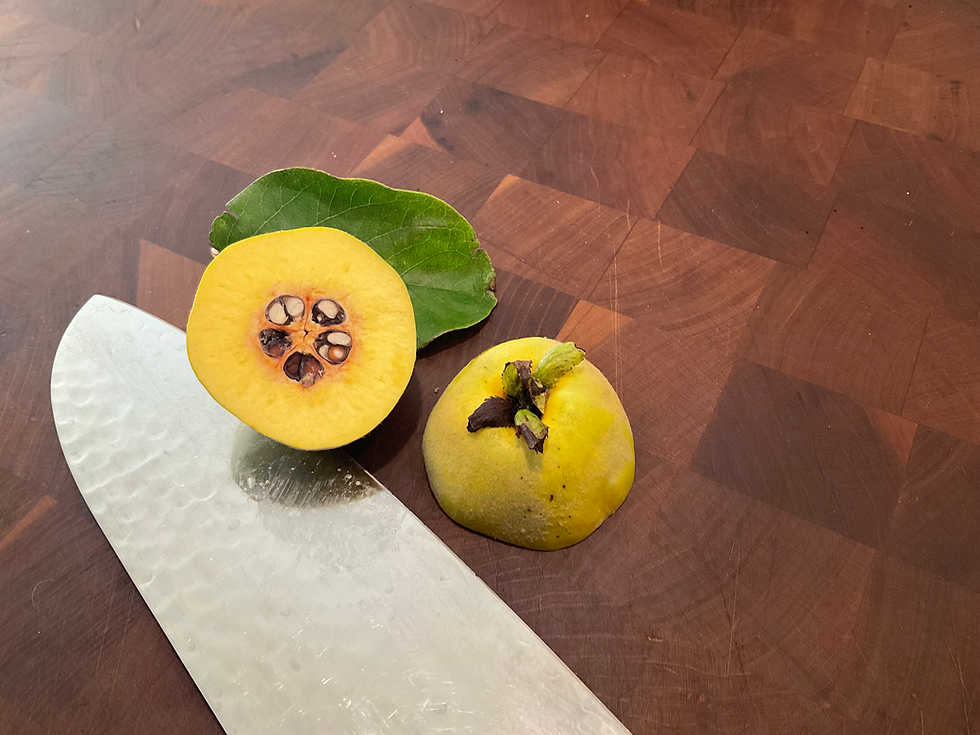
The tree typically grows 10–15 feet tall with a somewhat irregular form, gray bark, and large pale pink to white spring flowers. The fruit resembles a lumpy yellow apple or pear and ripens in late autumn.
Unlike apples or pears, quince is rarely eaten fresh. The fruit is extremely aromatic but firm and tart when raw. Cooking transforms it, softening the flesh and releasing a deep fragrance that has made quince a traditional ingredient in preserves, jellies, and pastes across Europe and the Middle East.
Reliability in the Maritime Northwest
High. Quince tolerates cool summers and maritime conditions well and produces fruit reliably in climates where apples and pears often struggle with disease.
Time to Fruit
3–5 years from grafted trees.
Pollination
Most varieties are self-fertile, though multiple trees can increase yields.
Grafting Compatibility
Quince is commonly used as rootstock for pears. The tree itself is usually grown on its own roots or quince rootstock.
Disease Pressure
Low to moderate. Quince is far less susceptible to many fungal diseases common to apples and pears, though fire blight can occasionally occur.
Pros
Reliable fruiting in cool climates
Exceptional fragrance and culinary value
Large ornamental spring flowers
Compact tree suitable for small orchards
Lower disease pressure than apples and pears
Field Notes
Plant in full sun for best fruit development
Allow fruit to remain on the tree late into autumn
Good airflow reduces the small risk of fungal disease
Reason It Appears in the Pendragon Design Palette
Quince produces consistent crops in maritime climates while requiring far less disease management than apples or pears. It’s actually one of the highest-pectin fruits, which is why traditional quince paste (membrillo) sets so firmly without added pectin.
Invasive Risk (Ecological Note)Very low. Quince does not demonstrate invasive tendencies in the maritime Northwest.
Asian Pear (Pyrus pyrifolia)
Tree Description / History
Asian pears originated in China and have been cultivated across East Asia for thousands of years. Unlike European pears, which soften when ripe, Asian pears remain crisp and are often described as a cross between an apple and a pear.
The trees typically grow 15–25 feet tall with a rounded canopy and glossy leaves. In spring they produce clusters of white blossoms similar to apple flowers, followed by round fruit that ripens from late summer through early autumn depending on the variety.
Reliability in the Maritime Northwest
High. Asian pears perform well in cool maritime climates and are generally more reliable here than European pears. They tolerate our mild winters and ripen fruit successfully during cooler summers.
Time to Fruit
3–5 years from grafted trees.
Pollination
Most Asian pears require cross-pollination. Planting two compatible varieties greatly improves fruit set and yield. Can be pollinated by European varieties is bloom overlap is compatible.
Grafting Compatibility
Commonly grafted onto pear rootstocks such as OHxF or seedling pear. They are also compatible with quince rootstock, though an interstem is sometimes required depending on the cultivar.
Disease Pressure
Moderate. Asian pears are somewhat resistant to many common pear diseases but can still be affected by fire blight in some conditions. Overall disease pressure is typically lower than apples in maritime climates.
Pros
Crisp fruit with excellent fresh-eating quality
Reliable production in cool climates
Attractive spring blossoms
Long storage life compared to many fruits
Field Notes
Plant in full sun for best fruit sweetness
Thin fruit early to improve size and prevent branch breakage
Maintain good airflow to reduce disease pressure
Reason It Appears in the Pendragon Design Palette
Asian pears produce consistent crops in maritime climates while offering a fruit texture and flavor distinct from European pears.
Invasive Risk (Ecological Note)
Low. Cultivated Asian pears don't exhibit invasive behavior in the maritime Northwest.
Mulberry (Morus alba, M. rubra, and hybrids)
Tree Description / History
Mulberries are fast-growing deciduous trees native to Asia, Europe, and North America. They’ve been cultivated for thousands of years, particularly in China where white mulberry (Morus alba) was central to silk production.
The trees typically grow 20–40 feet tall with a broad spreading canopy and distinctive variable-shaped leaves. In early summer they produce elongated berries that resemble blackberries. Fruit color ranges from white to red to deep purple depending on the species and cultivar.
Reliability in the Maritime Northwest
High. Mulberries tolerate cool summers, mild winters, and a wide range of soils. Once established they produce heavy crops with very little care.
Time to Fruit
3–6 years from young trees, sometimes sooner depending on the cultivar.
Pollination
Many cultivated mulberries are self-fertile. Some varieties are also female selections that produce fruit without pollination.
Grafting Compatibility
A piece of a desired variety (the scion) is attached to the roots of another mulberry seedling. The seedling provides the root system.
Disease Pressure
Low. Mulberries experience very few serious disease problems in maritime climates.
Pros
Extremely reliable fruit production
Heavy annual crops once established
Low maintenance and disease resistance
Attractive shade tree with broad canopy
Long-lived and durable
Field Notes
Plant in full sun for best fruiting
Site trees where fallen fruit will not create staining problems
Prune in winter to maintain manageable size
Reason It Appears in the Pendragon Design Palette
Mulberry produces large, dependable crops with minimal intervention while also functioning as a durable shade tree in edible landscapes. The fruit is prized for its taste. Among our favorites: Persian and Illinois Everbearing. Tolerant of varying soil types. Doesn't complain once established.
Invasive Risk (Ecological Note)
Low to moderate depending on species. Some white mulberry seedlings can spread in disturbed areas, though aggressive invasion is uncommon in maritime Northwest ecosystems.

Cornelian Cherry (Cornus mas)
Tree Description / History
Cornelian cherry is a small deciduous tree native to southeastern Europe and western Asia. Despite its name, it is not a true cherry but a member of the dogwood family.
The tree typically grows 15–25 feet tall with a dense rounded canopy and smooth gray bark that becomes attractively textured with age. One of its most distinctive traits is its extremely early bloom: small yellow flowers appear in late winter or very early spring, often before most other trees show signs of life.
By late summer the tree produces elongated red fruit that resembles small olives or elongated cherries.
Reliability in the Maritime Northwest
High. Cornelian cherry tolerates cool summers, wet winters, and a wide range of soils. Once established it produces fruit consistently in maritime climates.
Time to Fruit
4–7 years from young trees. The fruit is high in tannins when unripe, making it strongly astringent. Once fully ripe, the flavor softens and becomes tart and cherry-like.
Pollination
Two trees improve fruit production. Some cultivars are partially self-fertile, but cross-pollination generally increases yield.
Grafting Compatibility
Occasionally grafted onto seedling Cornus mas rootstock. Many nursery plants are also grown on their own roots.
Disease Pressure
Very low. Cornelian cherry is notably resistant to most common fruit tree diseases in maritime climates.
Pros
Very early flowers that support pollinators
Reliable fruit production
Attractive small landscape tree
Extremely hardy and durable
Long-lived with minimal maintenance
Field Notes
Full sun improves fruit production
Allow fruit to fully ripen for best flavor and tannis reduction
Netting may be necessary if birds discover the crop
Reason It Appears in the Pendragon Design Palette
Cornelian cherry combines ornamental value, early-season pollinator support, and dependable fruit production in cool maritime climates. Cornelian cherries are extremely high in vitamin C and antioxidants, which is one reason they’ve remained popular in Eastern European cuisines.
Invasive Risk (Ecological Note)
Low. Cornelian cherry has not shown invasive tendencies in the maritime Northwest.
American Persimmon (Diospyros virginiana)
Tree Description / History
American persimmon is a deciduous fruit tree native to the eastern United States. In the wild it can reach 30–50 feet, though cultivated trees are often smaller. The tree has a straight trunk, dark blocky bark, and glossy leaves that turn yellow to orange in autumn.
In late spring it produces small cream-colored flowers that develop into round orange fruit that ripens in autumn.
The fruit becomes soft when fully ripe and has a rich flavor often compared to apricot, pumpkin, or dates.
Reliability in the Maritime Northwest
Moderate to high. American persimmon tolerates maritime winters and cool summers well, though the fruit ripens more reliably in the warmest parts of a landscape.
Time to Fruit
4–8 years from grafted trees.
Pollination
Most American persimmons are dioecious, meaning separate male and female trees exist. Female trees require a male nearby for pollination, though some cultivars can produce fruit without pollination.
Grafting Compatibility
Commonly grafted onto American persimmon rootstock.
Disease Pressure
Very low. Persimmons experience few serious disease problems in maritime climates.
Pros
Distinctive autumn fruit with rich flavor
Extremely durable tree
Attractive bark and fall color
Minimal disease pressure
Long-lived
Field Notes
Full sun improves fruit ripening
South-facing slopes increase heat accumulation
Avoid cold air pockets where late frosts settle
American persimmon often outperforms Asian persimmon in the maritime Northwest because it is far more tolerant of cool summers, wet springs, and fungal pressure
Reason It Appears in the Pendragon Design Palette
American persimmon provides a durable, low-maintenance fruit tree capable of producing distinctive late-season fruit in maritime landscapes.
Invasive Risk (Ecological Note)
Low. The species has not shown invasive tendencies in the maritime Northwest.
Shipova (×Sorbopyrus auricularis)
Tree Description / History
Shipova is a rare hybrid between pear (Pyrus) and mountain ash (Sorbus). It was first recorded in central Europe and has been cultivated in small orchards there for centuries. The tree combines characteristics of both parents: the foliage resembles mountain ash while the fruit resembles small pears.
Trees typically grow 15–25 feet tall with a rounded canopy and clusters of white spring flowers. The fruit ripens in early autumn and resembles small russeted pears.
Reliability in the Maritime Northwest
Moderate to high. Shipova tolerates cool summers and maritime conditions well and can produce fruit in climates where heat-loving species struggle.
Time to Fruit
4–7 years from grafted trees.
Pollination
Generally self-fertile, though nearby pears or other shipova trees can improve fruit set.
Grafting Compatibility
Most commonly grafted onto pear rootstock.
Disease Pressure
Low to moderate. Shipova tends to experience fewer disease problems than many pear varieties.
Pros
Unusual hybrid fruit tree
Reliable in cool climates
Attractive foliage and flowers
Fruit suitable for fresh eating and preserves
A moderate-sized tree that can be kept manageable with pruning
Field Notes
Full sun improves fruit quality
Allow fruit to soften slightly before eating
Good airflow helps reduce disease pressure
Reason It Appears in the Pendragon Design Palette
Shipova combines the hardiness of mountain ash with the fruiting habit of pear, producing edible fruit in climates where many hybrid experiments fail.
Invasive Risk (Ecological Note)
Low. Shipova does not spread aggressively and is rarely encountered outside cultivation.

Kousa Dogwood (Cornus kousa)
Tree Description / History
Kousa dogwood is a medium-sized deciduous tree, typically reaching 20–30 feet. Native to Korea, China, and Japan. Has a layered branching structure and smooth mottled bark that becomes increasingly ornamental with age.
In late spring the tree produces large white bracts that resemble flowers, followed by round red fruit that ripens in late summer. The fruit has a soft orange pulp with a flavor often compared to mango or tropical fruit.
Reliability in the Maritime Northwest
High. Kousa dogwood performs very well in maritime climates and tolerates cool summers, wet winters, and a wide range of soils.
Time to Fruit
5–7 years from young nursery trees.
Pollination
Generally self-fertile, though multiple trees can improve fruit production.
Grafting Compatibility
Most trees are grown on their own roots or grafted onto Cornus kousa seedling rootstock.
Disease Pressure
Low. Kousa dogwood is much more resistant to the diseases that affect native flowering dogwood (Cornus florida).
Pros
Reliable small fruit crop
Excellent ornamental value
Attractive bark and structure
Strong disease resistance
Field Notes
Full sun improves fruit production
Protect young trees from strong drying winds
Well-drained soils produce healthier growth
Reason It Appears in the Pendragon Design Palette
Kousa dogwood provides both ornamental structure and edible fruit while performing reliably in maritime Northwest landscapes.
Invasive Risk (Ecological Note)
Low. Kousa dogwood does not demonstrate invasive tendencies in the maritime Northwest.

Japanese Raisin Tree (Hovenia dulcis)
Tree Description / History
Japanese raisin tree is a deciduous tree native to China, Korea, and Japan. It typically grows 25–40 feet tall with a broad rounded canopy and large glossy leaves.
In early summer the tree produces clusters of small white flowers. The fruit itself is small and relatively insignificant, but the flower stems (peduncles) swell and become thick and sweet as they mature.
These swollen stems are the edible portion of the tree.
Reliability in the Maritime Northwest
Moderate to high. Japanese raisin tree tolerates cool maritime conditions and grows well in the region, though fruit sweetness improves in warmer parts of the landscape. Needs well-draining but moist soil.
Time to Fruit
5–8 years from young trees.
Pollination
Generally self-fertile.
Grafting Compatibility
Rarely grafted. Most trees are grown from seed.
Disease Pressure
Low. The species experiences few serious disease problems in maritime climates.
Pros
Unusual edible crop
Attractive shade tree with broad canopy
Low disease pressure
Durable and long-lived
Tasting Note
The swollen flower stems develop a sweet flavor often compared to raisins, pears, or sugar cane. They're typically eaten fresh or dried.
Field Notes
Full sun improves sweetness of the edible stems
Warm summer exposure improves crop quality
Young trees benefit from protection from strong winds
Reason It Appears in the Pendragon Edible Landscape Design Palette
Japanese raisin tree produces a unique edible crop while functioning as a durable medium-to-large shade tree in edible landscapes. Adaptable to most soils, but thrives in fertile, moist, sandy loam.
Invasive Risk (Ecological Note)
Low to moderate. Occasional seedlings may appear, but the species has not demonstrated aggressive spread in maritime Northwest ecosystems.

Ginkgo (Ginkgo biloba)
Tree Description / History
Grow your own fossil. Ginkgo is one of the oldest tree species on Earth, often described as a living fossil. Fossil records show the genus existed more than 200 million years ago. Native populations survived in China, and the tree has since been cultivated across much of the world.
It grows as a large deciduous tree with a strong central trunk and distinctive fan-shaped leaves that turn bright yellow in autumn. Mature trees commonly reach 40–60 feet, though growth is slow and younger trees remain much smaller for many years.
Reliability in the Maritime Northwest
High. Ginkgo tolerates cool summers, wet winters, and urban conditions extremely well. It grows reliably across the maritime Northwest.
Time to Fruit (Seed Production)
15–25 years from young trees.
Pollination
Ginkgo trees are dioecious, meaning separate male and female trees exist. Only female trees produce the edible seeds, and a male tree must be nearby for pollination.
Grafting Compatibility
Most cultivated trees are grafted selections.
Disease Pressure
Extremely low. Ginkgo is largely free from serious insect or disease problems.
Pros
Extremely durable long-lived tree
Edible seeds used in traditional cuisine
Spectacular yellow fall color
Highly tolerant of urban conditions
Tasting Note
The edible portion is the seed inside the fruit. When cooked, the nut has a mild flavor and a soft, slightly chewy texture often compared to chestnut.
Field Notes
Plant in full sun for best growth
Female trees require a nearby male for seed production
Harvest fruit promptly once it falls
The fruit of female ginkgo trees smells strongly when it falls (butyric acid). Many urban plantings therefore use male trees only.
Bulletproof: Several ginkgo trees survived the atomic bombing of Hiroshima and still grow today.
Reason It Appears in the Pendragon Design Palette
Ginkgo provides an extremely durable long-lived tree that also produces edible seeds when female trees are pollinated. Huge colorful canopy in fall that is great for filling large spaces in interesting and useful ways. It's a legacy tree with culinary and medicinal uses.
Invasive Risk (Ecological Note)
Very low. Ginkgo does not spread aggressively and rarely naturalizes outside cultivation.

The Edge Cases: Tier 2 Fruit Trees
These are the fruit trees that reliably produce in maritime Northwest landscapes. They tolerate our cool summers, wet springs, and fungal pressure, and they reward good placement with consistent crops.
But this isn’t the entire palette.
There are other trees that grow well here but fruit less predictably—species like loquat, pomegranate, jujube, and olive that sit closer to the climatic margin.
In the next post, we’ll look at those Group 2 trees and how they can still play a valuable role in maritime Northwest edible landscapes.
Please contact us if you need help designing your landscape patio, yard, or acreage.
Frequently Asked Questions
What fruit trees grow well in the maritime Northwest?
Several fruit trees perform reliably in maritime Northwest climates, including peach (with resistant cultivars), fig, quince, Asian pear, mulberry, medlar, cornelian cherry, American persimmon, and strawberry tree. These species tolerate cool summers, wet springs, and the fungal pressure common to coastal climates.
Why do many fruit trees fail in the maritime Northwest?
The region combines cool summers, long wet springs, and high fungal pressure. Many fruit trees either cannot accumulate enough heat to ripen fruit or lose blossoms during rainy spring weather.
Are peaches difficult to grow in the maritime Northwest?
Peaches can grow very well when disease-resistant cultivars are selected. Varieties such as Frost and Indian Free are known for strong resistance to peach leaf curl and can produce reliable crops in coastal climates.
What fig varieties work best in the maritime Northwest?
Desert King is widely considered the most reliable fig for maritime Northwest climates because it produces a heavy breba crop that ripens during cooler summers.
Do fruit trees need pollinators in the maritime Northwest?
Some fruit trees are self-fertile, such as peaches, figs, medlar, and quince. Others benefit from cross-pollination. Asian pears and cornelian cherry generally produce better yields when multiple compatible trees are planted.
Are there fruit trees that also work well as landscape trees?
Yes. Several reliable fruit trees also provide strong ornamental or structural value, including Kousa dogwood, strawberry tree, mulberry, and ginkgo, which combine edible crops with attractive flowers, bark, or fall color.
How long does it take fruit trees to produce fruit?
Most fruit trees begin producing within 3–5 years after planting grafted nursery trees. Some species, such as persimmon or Japanese raisin tree, may take longer, typically 5–8 years.
Are these fruit trees invasive in the maritime Northwest?
Most cultivated fruit trees used in edible landscapes show very low invasive risk in the maritime Northwest. Some species, such as white mulberry, may produce occasional seedlings but rarely spread aggressively.
What fruit trees grow in Seattle, Vancouver BC, and the Puget Sound region?
Reliable fruit trees for maritime Northwest cities include fig, peach (resistant cultivars), Asian pear, quince, mulberry, medlar, cornelian cherry, and American persimmon. These species perform well in coastal climates influenced by the Pacific Ocean.


Comments