
The Fertilizer Myth: Why It Fails and What Actually Feeds Fruit Trees
Updated: May 3
Most fruit trees don’t need fertilizer. They need a natural support structure that's easy to create.
This will surprise most people, but I’ve never used fertilizer on a tree. Not once. That includes thousands of plantings, transplants, grafted trees, and long-term care across very different sites and conditions. Annuals are a different story, but trees are not annuals, and they don’t behave like them, nor, and most importantly, like us.
What’s more interesting isn’t that I haven’t used fertilizer. It’s that I’ve rarely found a situation where it actually made sense to.
What I see every spring is a kind of reflex. Fertilizer panic shows up all over social media, numbers and bad advice get discussed, and trees get fed because that’s what you’re supposed to do this time of year. The assumption is simple: if the tree is going to grow, produce, or stay healthy, it must need something added to the soil. That’s pure projection. That’s dangerous for our non-human neighbors.
People tend to treat trees the way they understand care in their own lives—if something is living, you feed it, you support it, you intervene to keep it healthy. That instinct works for domesticated animals, for gardens, for things that depend on regular input. But a tree isn’t a dependent system in that way. It’s adapted to operate within constraints, to regulate its own growth based on conditions, not continuous support. When we project our version of care onto it, we end up intervening where it doesn’t help, and often where it creates new problems. Over-pruning is a great example.
This tendency made us targets.
Do fruit trees actually need fertilizer?
In most cases, no. Fruit trees struggle not from lack of fertilizer, but from poor soil structure, limited oxygen, and weak biological activity.
Why fertilizer fails over time
Fertilizer provides short-term nutrients but does not fix underlying issues like compaction, poor drainage, or lack of microbial life—leading to repeated dependency.
What replaces fertilizer for fruit trees?
A functioning soil system replaces fertilizer. This includes proper drainage, oxygen in the root zone, active soil biology, and continuous organic matter inputs like mulch and plant guilds.
Sold on a fertilizer system that doesn't fit the home orchardist
The N–P–K fertilizer model, nitrogen, phosphorus, potassium, comes out of agricultural chemistry. It was built to simplify plant nutrition into something measurable, repeatable, and scalable. In large production systems, that made sense. You needed predictable inputs, and those three nutrients were the ones most likely to limit yield.
But that model didn’t stay in agriculture.
As fertilizers became widely available, the same simplified logic was packaged and sold for home use. Three numbers on a bag, a sense of balance, a clear prescription. It’s easy to understand, easy to apply, and it gives the impression that you’re doing something precise and necessary.
And it was marketed that way, consistently. Healthy lawns, perfect trees, clean, controlled landscapes. The message is subtle but persistent: growth and health come from adding the right product. If something looks off, you’re missing an input. If you want better results, you apply more of the right thing.
Over time, that becomes the default way of thinking. Not because people have studied soil systems, but because they’ve been shown, repeatedly, what “care” is supposed to look like. The model is simple, the messaging is constant, and the alternative, doing nothing, feels like neglect.
So it persists. Not because it’s always correct, but because it’s easy, familiar, and removes just enough uncertainty to act. And once that habit is in place, it carries itself forward, season after season, whether the system actually needs it or not.
Applying NPK to solve problems that aren’t there
Most of the time, no one has tested the soil, no one knows what’s actually present or available, and no one has defined a specific problem they’re trying to solve. The decision starts with a product, not a condition. And once you start there, everything else becomes guesswork dressed up as care.
The strange part is how confident it feels. The numbers on the bag—N, P, K—give the impression of precision. It looks measured, balanced, even scientific. But those numbers only describe what’s in the bag. They don’t describe your soil, your site, or your tree. They don’t tell you what’s already there, what’s accessible, or what’s limiting growth in the first place.
So what you end up with is a very specific input being applied to a system that hasn’t been observed, measured, or understood. And that’s where most of the problems begin.
Underneath all of this are two assumptions that almost no one questions. The first is that fertilizer is what keeps a tree healthy. The second is that more nutrients lead to more fruit.
Both sound reasonable. Both are wrong often enough to cause problems.
Fertilizer, especially nitrogen, doesn’t create health. It pushes growth. And those are not the same thing. A tree can be growing aggressively and still be structurally weak, more susceptible to disease, and less productive over time. In fact, that’s a common outcome when growth is pushed without regard for the conditions supporting it.
The same goes for production. A well-fed tree doesn’t prioritize fruit. It prioritizes expansion—more shoots, more leaves, more structure. Fruit tends to come when growth slows and the system stabilizes, not when it’s being pushed forward.
So the logic most people are operating on—feed the tree to make it healthier and more productive—starts from a misunderstanding of what fertilizer actually does, not how a tree works and what it needs.
Do your trees really need fertilizer?
Most trees don’t need fertilizer, especially once they’re established and growing in reasonably intact soil. If the tree is putting on steady growth, holding healthy leaf color, and not showing clear deficiency symptoms, adding fertilizer is unlikely to improve anything and often makes things worse. Where it can make sense is at the margins: newly planted trees in poor or disturbed soil, sites where topsoil has been stripped or compacted, or situations where a specific deficiency has been identified through testing or clear symptoms. Outside of those cases, fertilizer is usually being applied without a defined problem, which makes it a guess, not a solution.
What matters more is whether the system supporting the tree is functioning. A fruit tree isn’t responding to inputs in isolation, it’s responding to conditions.
Roots need access to oxygen.
Soil biology has to be active enough to cycle nutrients into usable forms.
Water has to move through the soil without pooling or disappearing too quickly.
And growth needs to stay in balance, not constantly pushed into excess.
When those conditions are in place, trees tend to regulate themselves. When they’re not, fertilizer doesn’t fix the problem, it just pushes growth on top of it. At a practical level, those conditions come down to four things:
1. Oxygen in the root zone
Roots need air as much as water. If the soil is compacted or stays saturated, roots can’t function properly, no matter how much fertilizer is present.
2. Active soil biology
The tree doesn’t pull nutrients directly from the soil. Microbes and fungi convert and move nutrients into forms the tree can actually use. Without that activity, nutrients can be present but unavailable.
3. Water moving correctly
Not too much, not too little, and not stagnant. The soil has to hold moisture while still draining and allowing air in. Most water problems are really structure problems.
4. Balanced growth
A healthy tree grows steadily, not aggressively. Excessive, fast growth usually means the system is being pushed, often at the expense of strength, resilience, and fruiting. That’s the system. If one of those is off, adding fertilizer won’t fix it. It just pushes the tree harder inside a system that isn’t working properly.
Heritage fruit trees on Orcas Island that are naturally fertilized. Mixed fruit orchard on Orcas Island that hasn't been fertilized in decades. Once in a Blue Moon Farm on Orcas Island. Their fruit trees are not commercially fertilized.
Orchards on Once in a Blue Moon Farm on Orcas Island. Apple trees more than 150 years old have not been fertilized commercially in decades.
How Do You Know the System Is Functioning Properly?
You don’t need a lab test to get a read on this. Most of it is visible if you know what to look for. A tree in a functioning system shows steady, moderate growth and consistent leaf color through the season. Its reproductive cycle is also a useful signal. It flowers and sets fruit in a way that’s proportionate to its age and stage, not excessively vegetative and not completely stalled.
You’ll also see a baseline level of resilience. The tree can tolerate normal environmental stress and routine pathogen exposure without significant decline. Its defensive responses are intact. That doesn’t mean it’s immune to serious diseases or that it won’t ever fail under pressure. Some diseases can overwhelm even well-supported trees. But in a functioning system, the tree is not constantly struggling, and minor issues don’t escalate into chronic problems.
Water moves through the soil without pooling, and the ground under the tree doesn’t feel lifeless or bare. Taken together, it looks stable rather than reactive, with fewer swings between stress and overgrowth.
Quince fruit from trees that are not commercially fertilized. Figs and plums from fruit from trees that are not commercially fertilized. Heritage pears from fruit from trees that are not commercially fertilized.
Compare to store bought: This is a clear signal of a healthy reproductive system. Fruit collected from Once in a Blue Moon farm which only fertilizes naturally.
If It’s Not Functioning, What Actually Fixes It?
This is where most people reach for fertilizer, because it’s the simplest lever available. Add something, expect a response.
But if the issue is oxygen, biology, or water movement, adding nutrients doesn’t correct any of those. It just pushes growth inside a system that’s already underperforming.
What actually fixes it is structural, not from a bag.
You’re not adding inputs. You’re changing the conditions the tree is growing in. That means improving how the soil holds air and water, building biological activity that can cycle nutrients properly, and covering the ground so the system can regulate itself instead of constantly resetting.
There’s a way to do that deliberately, using a small group of plants and materials that work together around the tree. Done properly, it replaces the need for fertilizer almost entirely and reduces the amount of intervention over time.
That’s the part most people never see, because it doesn’t come in a bag.
What replaces fertilizer isn’t a product. It’s a system. And if you build it poorly, it competes with your tree instead of feeding it.
If you want to understand what that system actually looks like, and how to build it in a way that supports the tree instead of competing with it, that’s where we go next. And it will save you money, time, and effort.
What a Fruit Tree Guild Actually Is
At its simplest, a guild is a group of plants growing together in a way that supports a central tree. The idea shows up in permaculture, but it often gets reduced to a list of “companion plants” without much clarity on what they’re actually doing.
Used properly, it’s more specific than that.
A functional fruit tree guild isn’t about diversity for its own sake, and it’s not about packing as many species under a tree as possible. It’s a small, intentional grouping of plants that each serve a role in supporting the conditions the tree depends on.
Those roles map directly to the system we just outlined.
Some plants help keep the soil open so roots can access oxygen. Some support microbial activity and nutrient cycling. Some regulate moisture at the surface. Others contribute organic matter or occupy space so the soil isn’t left exposed and resetting between seasons.
When those roles are filled, the system begins to support itself. Nutrients are cycled instead of added. Moisture is moderated instead of constantly corrected. Growth stabilizes instead of being pushed.
That’s the difference between a planted area and a functioning system.
And it’s why a well-built guild doesn’t act like an addition to the tree. Over time, it replaces the need for most of the inputs people are used to relying on.
Parts of the Guild
Foundation (Non-Negotiable)
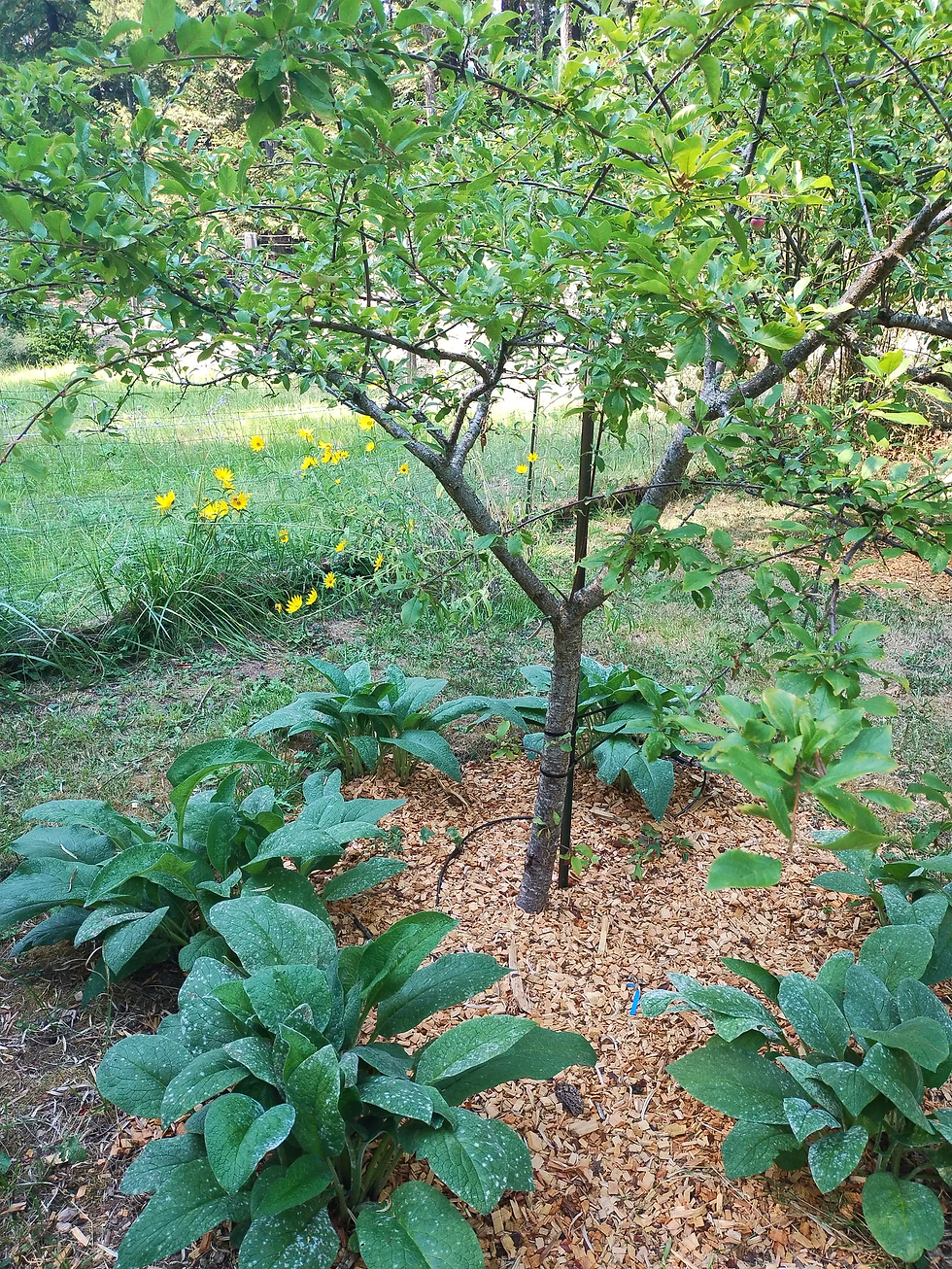
A continuous layer of wood chips, with a clear space around the trunk. This moderates moisture, protects the soil surface, and supports fungal activity. Without this, the rest of the system struggles to establish.
Suggested materials:
wood chips (preferred). Here on Orcas we use mostly fir and alder.
chipped prunings (disease-free)
coarse organic mulch
This level of mulch will also significantly reduce water demand.
Soil Openers (Oxygen and Structure)
A small number of deep-rooted plants placed outside the immediate root crown. These break up compaction over time and create channels for air and water, while pulling nutrients from deeper soil layers.
Suggested species:
comfrey (only use Russian comfrey hybrid)
daikon radish (seasonal)
chicory
Living Ground Layer (Biology and Moisture Regulation)
Low-growing plants forming a continuous cover. Their role is to protect the soil, moderate temperature and moisture swings, and support biological activity at the surface.
Suggested species:
white clover. Can be used in chop and drop along with the comfrey.
strawberries (bonus: food for you). Alpine strawberry works very well.
creeping thyme (drier sites)
Nutrient Cyclers (Slow Fertility)
Suggested species:
Russian comfrey (primary)
yarrow
plantain
Low Competition Fill (Optional, but Useful)
Light, non-aggressive plants that occupy remaining space. Their role is to prevent bare soil and add root diversity without competing heavily with the tree.
Suggested species:
chives
garlic
small perennial herbs
You’ll notice overlap between roles. Comfrey, for example, opens soil and cycles nutrients. Clover covers soil and supports biology. That overlap is part of what makes the system work without becoming complicated.
When these roles are in place, the system begins to regulate itself. Nutrients are cycled instead of added. Moisture is buffered instead of constantly corrected. Growth stabilizes instead of being pushed.
That’s the difference between planting under a tree and actually supporting it.
A Note on Biochar
You’ll hear biochar come up in this context, and for good reason. It can support soil structure and provide stable habitat for microbial life when it’s used correctly.
But it’s not a substitute for the system described above, and it doesn’t fix poor conditions on its own. In a functioning system, it can reinforce what’s already working. Outside of that, it tends to be overapplied or misunderstood.
We’ll cover it in more detail separately. Fertilizer is easy because it gives you something to do. It produces a response, and that response feels like progress.
But most of the time, it’s solving the wrong problem.
If the system under the tree isn’t functioning, fertilizer doesn’t fix it. It just pushes growth on top of it. That leads to more pruning, more disease pressure, more inconsistency, and eventually more inputs to correct the problems those inputs created.
There’s a different way to approach it.
When the conditions are right, the tree regulates itself. Nutrients are cycled instead of added. Water is buffered instead of constantly corrected. Growth stays balanced without being forced.
The work shifts from reacting to problems to building a system that doesn’t create them in the first place.
That’s what this is about.
If you want a tree that requires less intervention, produces more consistently, and actually improves over time, the answer isn’t in a bag. It’s in how the system is built.
And if you’d rather not figure that out on your own, that’s exactly the kind of work we do. We design and build edible landscapes and orchard systems that are structured to function this way from the start. Send me a message.
Because once the system is right, most of what people think they need becomes unnecessary.
Get in touch with us and view our services:


Comments